

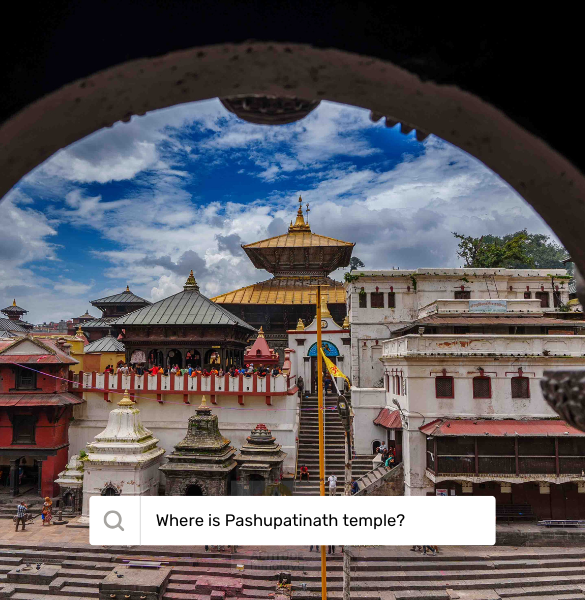
Pashupatinath Temple stands on the eastern bank of the Bagmati River, in the Deopatan neighborhood of Kathmandu, Nepal. It’s about 5 km north-east of Kathmandu’s city center.
- Coordinates: 27.7106° N, 85.3487° E.
- Altitude: 1,400 m.
- Heritage: UNESCO World Heritage Site (since 1979).
This is a living Shiva pilgrimage precinct, not a museum. The complex spans 264 hectares of temples, ashrams, ghats, and forest, administered by the Pashupati Area Development Trust (PADT) under the Government of Nepal.
Map and area orientation inside the Pashupati precinct
The first thing to understand about the Pashupatinath area is scale. You’re not arriving at a single doorway. You’re entering a broad sacred landscape where shrines, footpaths, river embankments, and ashrams sit in active use.
Key area anchors you’ll hear named on-site:
- The main pagoda shrine (the sanctum area, with access boundaries)
- Bagmati River embankments (including the aarti viewing side)
- Arya Ghat (royal cremations)
- Bhasmeshwar Ghat (public cremations)
- Surya Ghat (morning bathing)
- Mrigasthali (deer park, caves, and ashrams across the river)
- Guhyeshwari and Vasuki shrine
- The 108 shivalinga rows
- Pandra Shivalaya
For a dedicated mapping-and-area walkthrough, use the Pashupatinath location, map, and area guide.
How to reach Pashupatinath Temple from Kathmandu
Arriving is straightforward by Kathmandu standards, but timing matters. Morning light is crisp in October–March, and the riverfront feels most orderly early.
From Tribhuvan International Airport (TIA): Tribhuvan International is 4 km away. A taxi typically takes about 15 minutes.
By local bus: Take a local bus from Ratna Park to Gaushala, then walk about 10 minutes.
I’ll be slightly picky here: the last stretch on foot can feel visually busy. Give yourself a little buffer so you’re not rushing into a sacred space already irritated by traffic.
Entry fees and the access boundary you must know
Entry fees are set by visitor category:
-
Nepali / Indian: Free
-
SAARC nationals: NPR 200
-
Other foreigners: NPR 1,000
A clear constraint: Non-Hindus may view the main shrine only from across the river. That’s the access boundary. It shapes your visit plan, your photography plan, and where you’ll stand for darshan.
If you want the broad “plan your visit” view in one place, the main Pashupatinath visitor guide keeps fees, timings, and site notes together.
Bagmati aarti timing, best spot, and where to stand
The daily river ritual is fixed and practical to plan around.
Bagmati Aarti: 6:15 PM daily
Duration: about 45 minutes
Best spot: Western embankment
Arrival recommendation: 5:30 PM for a front-row view
This is one of the few moments where the whole precinct feels synchronized, bells, lamps, and the river all pulling attention to the same line of sight.
For the official schedule page, use the timings and daily ritual listing.
Cremation ghats and photography limits (read this before you lift a camera)
The Bagmati ghats are not a staged cultural display. They are active rites.
Named ghats you’ll encounter:
-
Arya Ghat: royal cremations
-
Bhasmeshwar Ghat: public cremations
-
Surya Ghat: morning bathing
A strict rule is stated plainly: Photography is forbidden at active cremation ghats. Plan to observe with restraint. And if you’re here for documentary work, you’ll do better by learning the boundary early than by testing it in the moment.
Puja bookings and morning office details
Puja offerings are listed with set prices and a clear booking window.
Puja types and fees:
-
Rudrabhishek: NPR 7,500
-
Mahamrityunjaya: NPR 2,500
-
Special Sankalpa: on request
Bookings open at 4:30 AM at the south office.
That early window is not decorative. It’s the practical rhythm of the precinct, and it’s where order still holds before the day crowds thicken.
The living precinct: priests, sadhus, and governance
Pashupatinath is administered by PADT under the Government of Nepal. That governance matters because it frames access, protection, and the continuity of ritual space across the full 264 hectares.
Ritual authority is also present in named roles:
-
The Bhatta priests, traditionally drawn from South Indian Brahmin lineages, perform inner sanctum rituals.
Across the river and through the ashram areas, you may see resident ascetic communities:
-
Naga, Aghori, and Vaishnav sadhus reside year-round in Mrigasthali caves and ashrams.
This is where I’d slow down, honestly. The most meaningful observation doesn’t come from collecting scenes. It comes from staying still long enough to see what repeats, what’s guarded, and what’s offered freely.
Festivals that change crowding and movement
On festival days, the precinct’s movement patterns change. If you’re mapping the Pashupatinath Temple location for a field schedule, treat these dates as a different operating mode.
Major festivals named for Pashupatinath:
- Maha Shivaratri (Feb/Mar)
- Teej
- Bala Chaturdashi
- Janai Purnima
For the calendar context, use the events and festival listing.
Decision notes for a clean, respectful visit plan
A few decisions settle the day quickly.
- Go early if you care about quiet observation.
- Arrive by 5:30 PM if you care about aarti sightlines.
- And keep the river boundary in mind if you’re a non-Hindu visitor.
The one limitation that catches people off guard is access to the main shrine. It’s not negotiable on-site, and it shouldn’t be a surprise after you’ve already traveled across Kathmandu.
If you want deeper background before you arrive, the religious and cultural significance guide is the cleanest place to start.