

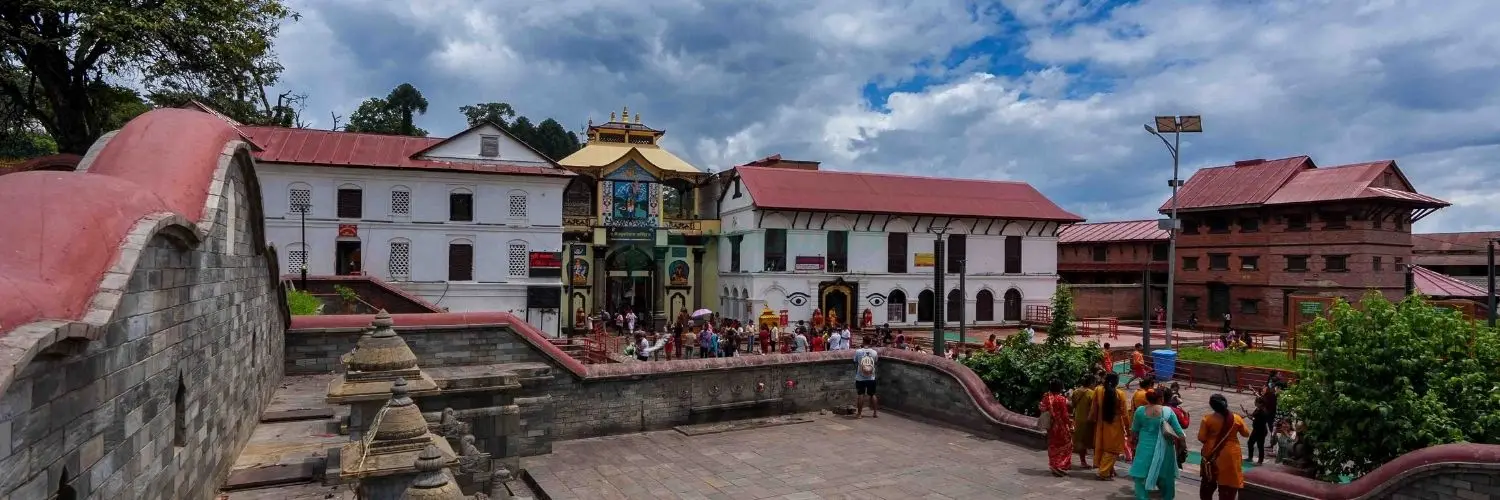
Pashupatinath Temple follows a steady rhythm each day, with early darshan, abhishekam, a brief midday closure, and the Bagmati Aarti at 6:15 PM. The timings below are the ones you’ll plan around.
-
4:00 AM Temple opens
-
8:30 AM Morning bhog (first viewing of the deity)
-
9:30 AM Main puja, abhishekam with Bagmati water and bilva leaves
-
1:30 PM Midday closure (inner sanctum closes briefly)
-
5:00 PM Reopening (evening darshan)
-
6:15 PM Bagmati Aarti (daily)
-
8:00 PM Shayan Aarti (final rites)
For the full timing page in one place, use this Pashupatinath Temple timings guide.
Pashupatinath Temple timings for darshan
The simplest way to think about Pashupatinath Temple timings is this: early morning is calm, and evening builds toward aarti. If you want a quieter threshold, aim for the hours right after 4:00 AM.
The inner sanctum opens for early darshan when the temple opens at 4:00 AM. You’ll feel the place working as a living shrine, not as a staged monument, and that difference matters.
At 8:30 AM, the morning bhog is the first viewing of the deity in softer morning light. It’s also a natural moment to slow down, because the day’s movement hasn’t peaked yet.
At 9:30 AM, the main puja begins, with abhishekam using Bagmati water and bilva leaves. This is a defined ritual time, not a flexible window, so don’t arrive late and expect it to “still be happening.”
Bagmati Aarti timing and where to stand
Bagmati Aarti is at 6:15 PM daily. The duration is about 45 minutes.
The best spot is the western embankment. Arrive by 5:30 PM for a front-row view. That extra time isn’t optional if you care about where you’ll stand.
Photography has a hard boundary here too. Photography is forbidden at active cremation ghats, and that rule isn’t negotiable.
Entry fees and access boundaries
Entry fees are simple and posted by category.
-
Nepali / Indian: Free
-
SAARC Nationals: NPR 200
-
Other Foreigners: NPR 1,000
One restriction needs to be clear before you arrive: Non-Hindus may view the main shrine only from across the river. Plan your time on the embankments and across-river viewpoints accordingly.
If you want an official overview that includes timing, tickets, and on-site context, keep the main Pashupatinath Temple guide open while you plan.
Puja timings and booking details (Rudrabhishek, Mahamrityunjaya)
Puja bookings open at 4:30 AM at the south office. Show up early. The line is part of the day.
Available pujas and listed prices:
-
Rudrabhishek: NPR 7,500
-
Mahamrityunjaya: NPR 2,500
-
Special sankalpa: On request
If you’re coming for a specific rite, don’t improvise this part. Confirm your timing around the 4:30 AM booking opening, then build the rest of your visit around darshan and the aarti.
Ghats and viewing etiquette (Arya Ghat, Bhasmeshwar Ghat, Surya Ghat)
The ghats are not a side attraction. They’re part of the sacred working landscape on the Bagmati.
-
Arya Ghat: Royal cremations
-
Bhasmeshwar Ghat: Public cremations
-
Surya Ghat: Morning bathing
The key rule again, because people test it: photography is forbidden at active cremation ghats. Keep your phone down. Watch with restraint.
Where you are, and how to reach the temple complex
Pashupatinath rises on the eastern bank of the Bagmati River, in the Deopatan neighborhood of Kathmandu, Nepal, about 5 km northeast of the city center. The complex spans 264 hectares of temples, ashrams, ghats, and forest, and it has been recognized as a UNESCO World Heritage Site since 1979.
The coordinates are 27.7106° N, 85.3487° E.
Getting here is straightforward:
-
Tribhuvan International Airport is 4 km away, taxi in about 15 minutes
-
Local bus from Ratna Park to Gaushala, then a 10-minute walk
For a map-first planning view, use this location and area guide.
What to see inside the wider Pashupati area
If you have time beyond the main threshold moments, the wider area holds specific shrines and spaces that reward a slower pace.
Major named places include the main pagoda, Vasuki shrine, Guhyeshwari, the 108 shivalinga rows, Mrigasthali deer park, and the Pandra Shivalaya.
Sadhus, including Naga, Aghori, and Vaishnav sadhus, reside year-round in the Mrigasthali caves and ashrams across the river. Keep your distance and your manners. A respectful gaze is enough.
Best time of year and festival pressure on timings
October to March brings crisp Himalayan light. That’s the cleanest window for walking the complex and reading the stone and wood details without heat haze.
Maha Shivaratri (Feb/Mar) is the spectacle of the year, and it changes everything about timing, crowd density, and how long you’ll wait. Expect pressure at every chokepoint. I think it’s worth it if you’re coming for the living ritual intensity, but if your priority is calm darshan, pick an ordinary weekday morning instead.
For festival dates and context, use this events and festivals page.
Practical conduct that keeps your visit smooth
Dress and behavior aren’t “tips” here. They’re part of access.
Keep your voice low near the main shrine and along the river. Don’t block narrow paths when you stop. And don’t treat the ghats as a photo backdrop.
One more boundary, because it shapes your route: Non-Hindus may view the main shrine only from across the river. That viewpoint can still be meaningful, especially near the aarti, but it’s a different kind of seeing.
Planning your day around the timings (two simple templates)
A simple morning plan:
Arrive close to 4:00 AM. Take early darshan. Stay through 8:30 AM morning bhog if you want a clearer view in softer light. Leave before midday heat and before the 1:30 PM closure compresses movement.
A simple evening plan:
Arrive by 5:30 PM. Take your place on the western embankment. Stay for 6:15 PM Bagmati Aarti (about 45 minutes). Keep your phone down near sensitive spaces.
Neither plan is “better.” They’re different moods, and you’ll know which one you need.